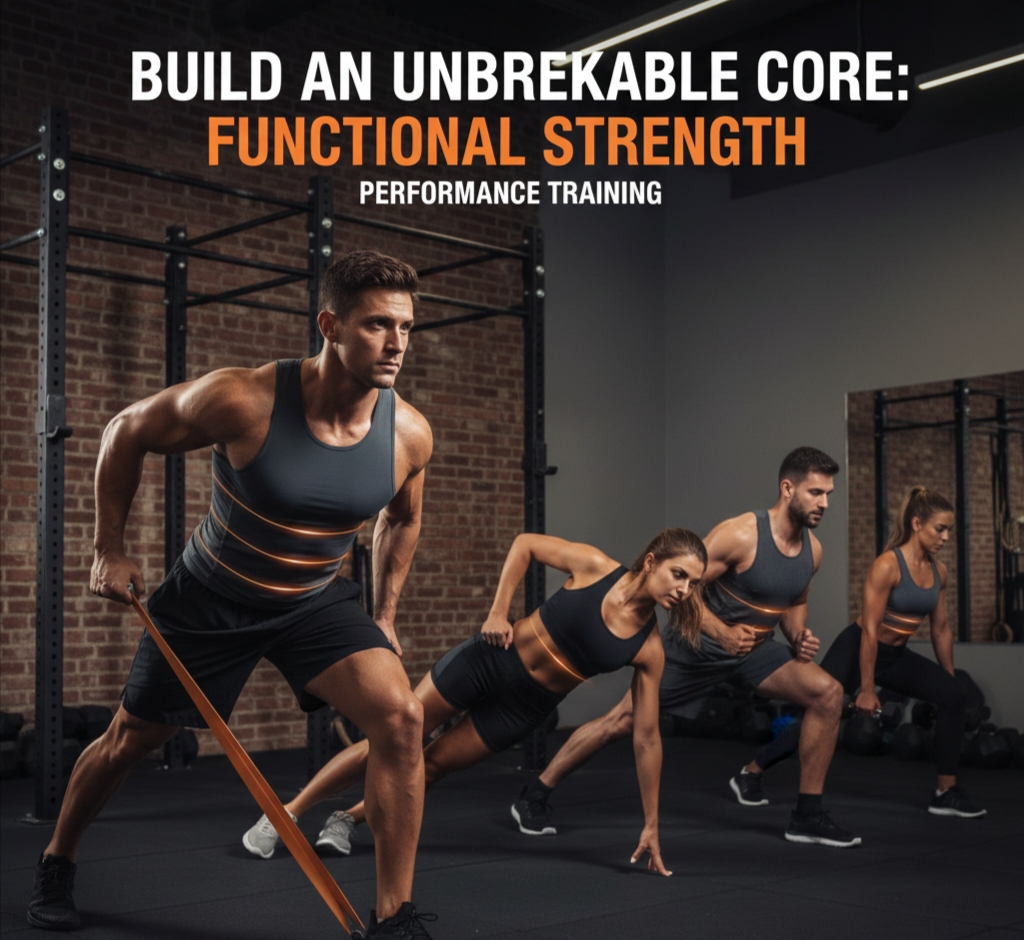
Unlock true power! Discover 5 core principles of functional strength to build a powerful core, improve mobility and stability, and enhance injury prevention for all-around athleticism.
In performance training, “strength” is often equated with how much weight you can lift in isolation (like a bench press or bicep curl). But true athletic ability and resilience depend on functional strength—the ability of your muscles to work together to produce, absorb, or stabilize force across multiple joints.
Functional training is about teaching your body to move efficiently and powerfully in three dimensions, preparing it for the unpredictable demands of sports and real life. It is the key to unlocking true athletic potential and maximizing injury prevention.
Ready to move beyond isolated exercises? Here are 5 core principles of functional strength that will transform your athletic conditioning.
1. Prioritize Core Stability Over Core Flexion
Your core’s primary job is to stabilize your spine, not just curl it.
- The Principle: While crunches target movement, functional core training focuses on exercises that resist movement—like anti-rotation (Pallof press), anti-extension (planks), and anti-lateral flexion (farmer’s carry).
- Why It Matters: A strong, stable core is the central power station for all athletic movement. Training it for core stability ensures efficient transfer of force from your lower body to your upper body (and vice versa), which is crucial for throwing, swinging, jumping, and preventing lower back pain.
2. Integrate Multi-Joint, Multi-Planar Movements
The body rarely moves one joint at a time in isolation.
- The Principle: Use compound exercises that require multiple joints to move simultaneously, and incorporate movements in all three planes of motion (sagittal, frontal, and transverse). Think lunges with a torso rotation, kettlebell swings, or step-ups.
- Why It Matters: Training across multiple planes mimics real-world and sports demands, improving coordination and ensuring that your strength is usable. This integrated approach is essential for true power development and full-spectrum athletic conditioning.
3. Balance Mobility and Stability
Optimal movement requires the right mix of movement (mobility) and control (stability).
- The Principle: Identify areas that lack mobility (e.g., hips, thoracic spine) and work to increase their range of motion. Simultaneously, strengthen the stabilizing muscles around those mobile joints (e.g., rotator cuffs, glutes).
- Why It Matters: Mobility without stability is a recipe for injury, while stability without mobility limits performance. Achieving the right balance ensures your body can access its full range of motion safely, improving overall movement quality and supporting mobility and stability.
4. Ground-Up Strength: Foot and Ankle Foundation
All force in locomotion and lifting begins and ends with the feet.
- The Principle: Pay attention to ankle mobility, foot intrinsics, and balance. Incorporate exercises like single-leg balances, barefoot or minimal shoe training, and dynamic ankle drills to improve proprioception (your body’s awareness in space).
- Why It Matters: Weak or stiff feet compromise the entire kinetic chain, leading to compensation up the body (knees, hips, and back). Building strength from the ground-up enhances stability, balance, and the efficiency of force transfer, aiding significantly in injury prevention.
5. Train Movements, Not Just Muscles
Shift your focus from aesthetic gains to movement competency.
- The Principle: Structure your workouts around fundamental human movement patterns: squat, hinge, push, pull, carry, and rotate. Use varying tools (kettlebells, dumbbells, cables, bodyweight) to challenge these patterns in different ways.
- Why It Matters: Training movements, not isolated muscles, ensures that your entire muscular system learns to activate synergistically, which is the definition of functional strength. This holistic approach produces far greater performance transfer to sports and dramatically lowers the risk of activity-related injuries.
Move Better, Live Stronger!
By embracing these 5 core principles, you are moving toward a highly resilient, powerful, and injury-resistant physique. Functional strength is about making your body adaptable and capable—the ultimate goal of performance training.
Which of these functional strength principles will you integrate into your next workout? Share your plan in the comments below!