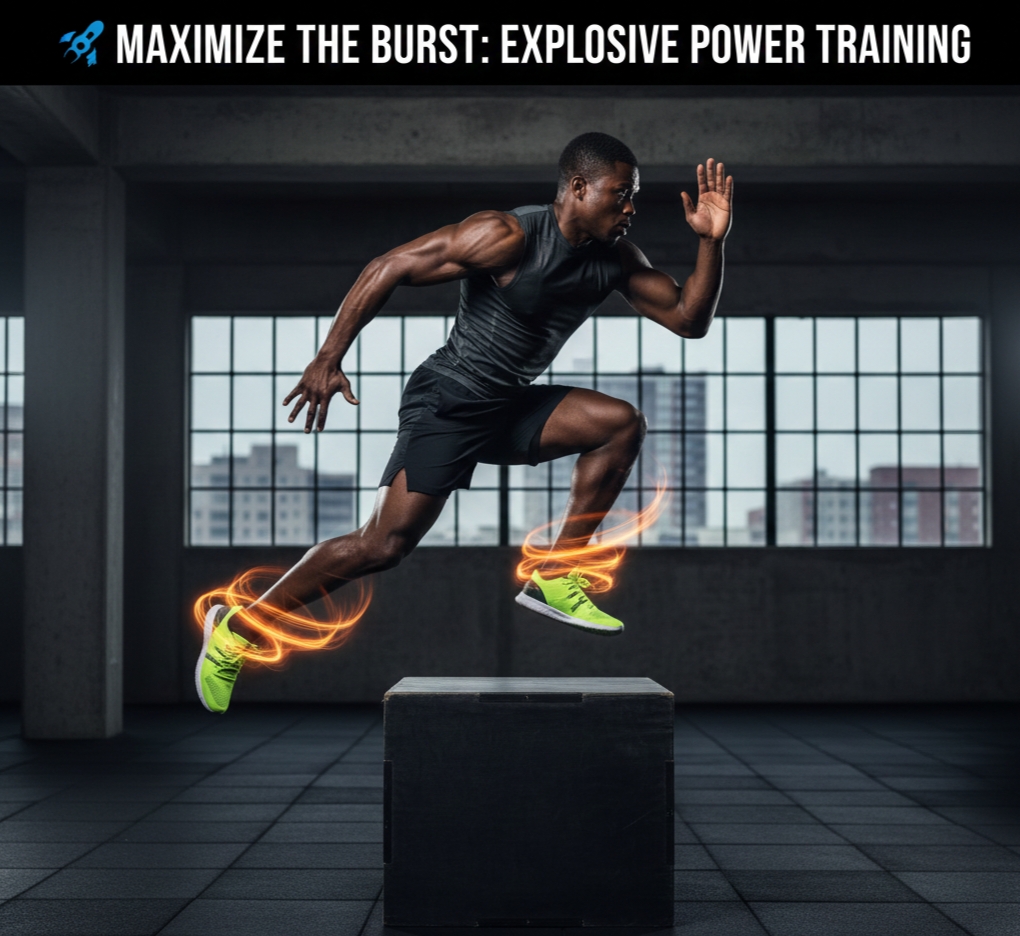
Ignite your speed and vertical! Master 5 pillars of explosive power training to boost speed and agility, optimize rate of force development, and achieve peak athletic performance.
In many sports—from basketball and football to sprinting and martial arts—the difference between success and failure is often measured in milliseconds. This instantaneous acceleration requires explosive power training: the ability to generate the maximal amount of force in the shortest amount of time.
Explosive power is the marriage of strength and speed, known scientifically as the Rate of Force Development (RFD). Focusing on this ability is critical for improving jumping height, sprinting velocity, and overall athletic performance.
Ready to unlock your fast-twitch fibers? Here are 5 essential pillars of training that build game-changing explosive power.
1. Prioritize Intent: Move Quickly, Always
Power training is about quality and speed, not volume and fatigue.
- The Principle: During every repetition of a power-focused exercise (like squats, bench presses, or Olympic lifts), the intent must be to move the weight as fast as humanly possible, even if the weight itself is heavy and moves slowly. The neurological drive to accelerate is the key stimulus.
- Why It Matters: Training with maximal intent optimizes the communication between the nervous system and the muscles, training the body to fire muscle fibers rapidly. This neurological adaptation is crucial for improving the Rate of Force Development (RFD).
2. Master Plyometrics and Jump Training
Plyometrics are foundational to teaching the body how to absorb force and immediately redirect it.
- The Principle: Integrate exercises that utilize the stretch-shortening cycle (SSC)—rapid eccentric loading followed by immediate concentric shortening. Examples include box jumps, depth jumps, and bounding drills. Always focus on minimizing ground contact time.
- Why It Matters: Plyometrics improve the elasticity of muscles and tendons, enhancing the speed at which you can transition from absorbing a landing (eccentric phase) to exploding upward (concentric phase). This direct training is vital for increasing vertical jump and improving speed and agility.
3. Exploit the Triple Extension
Most powerful human movements share a common kinetic chain sequence.
- The Principle: Focus on exercises that involve the rapid, simultaneous extension of the hips, knees, and ankles (the triple extension). The Olympic lifts (Clean and Jerk, Snatch), kettlebell swings, and jump shrugs are prime examples.
- Why It Matters: This sequence is the power mechanism for running, jumping, and throwing. By training the body to maximize force generation through the triple extension, you create a synchronized, powerful burst that directly translates to better overall athletic performance.
4. Incorporate Contrast and Complex Training
This method pairs heavy strength work with light, explosive work.
- The Principle: Perform a heavy set of a compound lift (e.g., heavy squat) immediately followed by a set of a biomechanically similar plyometric movement (e.g., bodyweight jump squats or broad jumps). Allow full rest before repeating the complex.
- Why It Matters: The heavy strength work activates high-threshold motor units. The immediate transition to the fast, explosive movement utilizes that high neural activation to produce higher power output, enhancing post-activation potentiation (PAP) for superior explosive power training.
5. Respect Recovery for the Central Nervous System (CNS)
Explosive training is neurologically taxing and requires adequate rest.
- The Principle: Keep volume relatively low and intensity high during power sessions. Avoid training power while highly fatigued. Ensure full rest periods between sets (3–5 minutes) to allow for complete ATP and CNS recovery before the next maximal effort.
- Why It Matters: Power training demands fresh muscles and a fresh central nervous system. Attempting to train explosiveness while fatigued promotes slow, compensatory movements, which actually trains your body to be slower. Quality rest is non-negotiable for maximizing rate of force development.
Turn Strength into Speed!
Explosive power training is the bridge between the weight room and the playing field. By applying these five pillars, you will develop the neural drive and muscular elasticity needed to outpace, outjump, and outperform the competition.
What explosive movement are you currently working to improve? Share your power goals in the comments below!