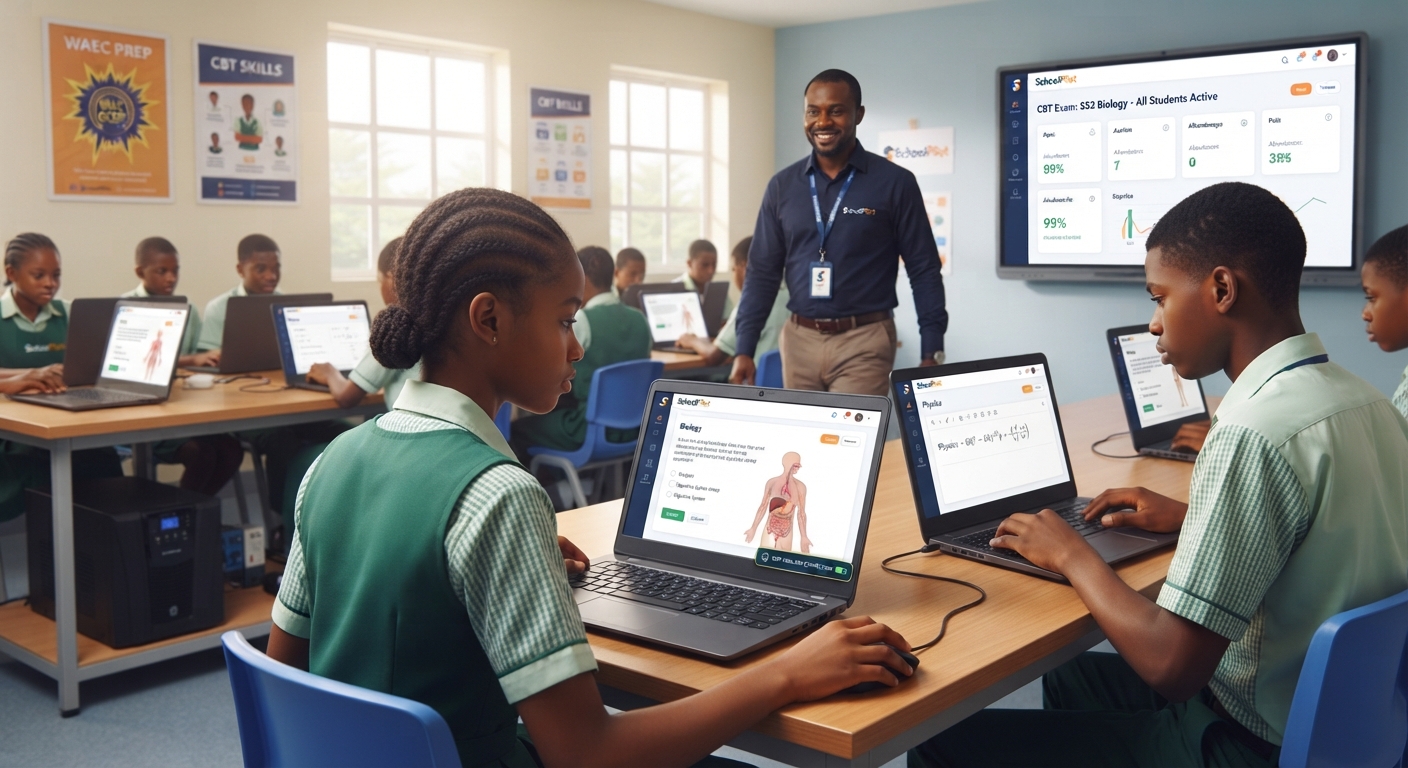
Ask any ICT coordinator or exam officer in a Nigerian secondary school what keeps them up at night during exam week, and the answer rarely has to do with syllabus coverage. It has to do with what happens the moment twenty or fifty candidates are logged into a computer-based test (CBT) and the network drops—or the power cuts out mid-session.
Computer-based testing is now a standard part of modern assessment, and students preparing for major national exams need regular practice on screens rather than encountering digital testing for the first time in an external hall. Yet many schools try to run CBT using tools built for stable broadband and uninterrupted power. The result is predictable: frozen screens, anxious candidates, lost answers, and a frantic scramble back to paper.
Running reliable CBT in Nigerian school does not require buying a complex server room or overhauling your entire computer lab. It requires software and exam workflows designed around real classroom and infrastructure conditions—like the CBT tools built into SchoolPilot.
1. Designing Exams Around Dropped Lines and Power Cuts
In a typical school environment, connectivity can dip right in the middle of a timed paper, and a sudden power outage can cause a lab computer to shut down or restart. When a testing platform depends on a constant, unbroken internet connection to save progress, a brief network hiccup can wipe out a student’s momentum or force an entire session to be rescheduled.
A resilient CBT setup handles interruptions quietly in the background:
-
Local Progress Retention: Once a paper starts, answers should stay safely stored on the candidate’s device if the internet drops and sync automatically once the connection returns.
-
Restart Recovery: If a lab computer powers down and reboots during an outage, reopening the exam app should bring the student right back to where they stopped with their recorded answers intact.
-
Locked Exam Environment: A dedicated exam application keeps candidates focused on the active paper without wandering across open browser tabs.
2. Moving Beyond Simple Multiple-Choice Questions
A common criticism of school CBT is that it reduces assessment to basic A-B-C-D guessing. While objective questions are great for fast auto-marking and broad coverage, subjects like mathematics, sciences, English comprehension, and technical courses demand more depth.
Effective digital assessment gives teachers room to test real understanding:
-
Rich Question Formats: Combining objective questions with structured responses, short answers, essays, diagram labelling, matching, ordering, or practical components lets teachers evaluate reasoning as well as recall.
-
Proper Mathematical & Scientific Formatting: Equations, symbols, and diagrams need to render cleanly on screen—and print clearly if a school also needs physical copies for certain halls or candidates.
-
Targeted Exam Practice: Setting practice papers modeled on WAEC, NECO, and BECE formats helps JSS 3 and SS 3 students build speed, confidence, and screen familiarity well ahead of external exams.
3. Giving Teachers Time Back Without Bypassing Their Judgment
Setting fresh questions, typing marking guides, drawing clean diagrams, and reviewing scores across multiple classes takes hours that busy subject teachers rarely have to spare. At the same time, schools are rightly cautious about letting unverified automation write exam items or student comments unchecked.
The healthiest middle ground is teacher-in-the-loop assistance:
-
Drafting Support, Not Blind Automation: AI tools can help generate initial question drafts, curriculum-aligned practice items, diagrams, or report card comment drafts in seconds.
-
Human Review and Approval: Subject teachers stay firmly in control—editing, rejecting, or approving every question and comment before it enters the question bank or reaches a student’s report card.
-
Student Privacy Protection: Keeping student personal identifiers out of external AI prompts protects learners’ privacy from the start.
4. Connecting Exam Scores Directly to Results and Records
One of the biggest hidden time-sinks in schools happens after the exam ends. When CBT scores, theory marks, continuous assessments, and fee records live in separate spreadsheets or disconnected tools, compiling broadsheets and releasing results becomes slow and error-prone.
When exams sit inside a unified school management system in nigeria like SchoolPilot, auto-graded scores flow directly into the school’s broader academic records, reducing manual re-entry and helping administrators move smoothly from assessment to final report cards.
Making Digital Assessment Work for Your School
You do not need a massive budget or an IT overhaul to make computer-based testing dependable. Start with one class or one term’s assessments, use the computers and devices your school already has, and choose tools built to keep working when power or internet fluctuates.
If you are looking for a practical way to run CBT, manage results, and streamline daily school operations under one roof, visit SchoolPilot.org.ng to explore how it works or book a demo for your school.